
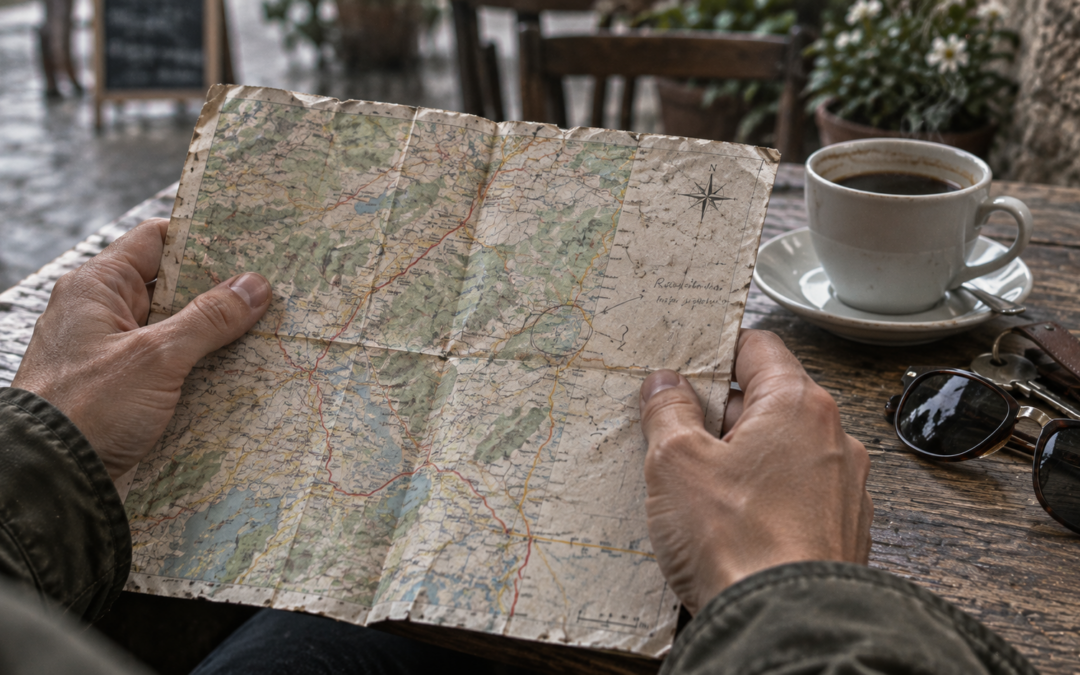
There is a fear that modern travel has almost erased: the fear of no longer knowing where you are.
GPS in our pocket, route mapped out, reviews read in advance, we now travel without ever getting lost. Everything is signposted, planned, reassuring. And yet something is lost in never losing our way.
What is found only by getting lost
To get lost is not merely a wrong turn. It is also the only way to meet what no guidebook mentions: a forgotten lane, a face, a silence, a landscape we had not come to see. The finest moments of a journey are rarely the ones we had planned.
When we know exactly where we are going, we no longer truly look. We follow. Getting lost wakes attention back up: suddenly every detail matters, because it might be a landmark, or a discovery.
Losing one’s way as a method
To travel differently is sometimes to accept not controlling everything. Not to put oneself in danger, but to leave room for chance: to take the street that wasn’t on the map, to get off one stop too early, to follow a hunch rather than an arrow.
Deliberate wandering is not recklessness. It is a way of giving travel back its share of the unknown: the share that makes us return transformed, and not merely informed.
Getting lost to find oneself
There is, in no longer knowing where you are, a rare kind of freedom. Detached from familiar landmarks, we sometimes discover ourselves anew: more attentive, more present, more alive.
Perhaps this is the deepest meaning of self-guided travel: not to follow a path traced by others, but to learn to find one’s own, even at the cost of getting a little lost along the way.